Skip to content




May 6, 2026
How Consumer Product Design Impacts Retail Success: From Concept to Shelf
READ TIME: 6.4 MINS
Consumer product design directly determines retail success because every choice made during the design process shapes shelf appeal, return rates, review scores, and sell-through velocity. In a market where trend cycles compress every season and retailers like Target, Walmart, and Amazon raise the bar on packaging, sustainability, and digital assets, design quality is no longer just a creative concern. It is a commercial one.
Brands that treat consumer product design as a connected, data-driven discipline ship better products faster, protect margin, and earn stronger retailer relationships. The operational backbone that makes this possible is product lifecycle management (PLM), supported by integrated CAD, visualization, and engineering tools.
Why Product Design Defines Retail Performance
Product design is the most important factor in retail performance because it controls cost, quality, speed, and consumer experience before a product ever reaches the shelf. Every downstream metric retail leaders track traces back to decisions made during the development process.
Design impacts retail through several measurable channels:
- Shelf and listing appeal that drives conversion at the point of decision
- Quality and fit that lower return rates and chargebacks
- Speed to market that captures trend windows ahead of competitors
- Cost engineering that protects margin against retailer markdowns
- Compliance and sustainability that meet safety standards and retailer scorecards
When any of these break down, retail performance suffers regardless of how much marketing spend follows.
The Consumer Product Design Process
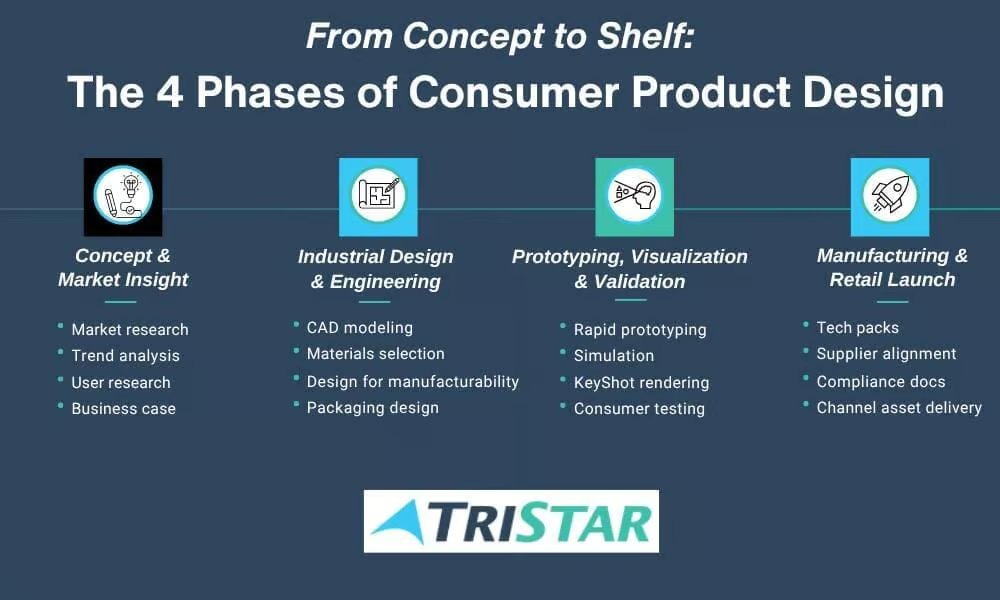
The consumer product development process moves through four connected phases, each with defined inputs, outputs, and decision gates. Strong execution at every stage is what turns concepts into market-ready products.
1. Concept and Market Insight
This phase translates consumer demand into a defined product opportunity. Teams conduct market research, trend analysis, competitive teardowns, and user research to understand customer needs and consumer behavior. Designers and product managers define the target end user, channel strategy, retailer fit, and business case. Strong concept work prevents the most expensive mistake in consumer product development: building the wrong product well.
2. Industrial Design and Engineering
In this phase, designers and engineers convert insight into a manufacturable product. Industrial design defines form, ergonomics, and brand language while mechanical design handles structure, fit, and performance. CAD modeling in tools like PTC Creo establishes the geometry that drives every downstream deliverable. Material selection, design for manufacturability, design for cost, and packaging design happen in parallel, usually involving a multidisciplinary team across ID, engineering, sourcing, and marketing.
3. Prototyping, Visualization, and Validation
This phase proves the product works and looks right before tooling commits. Teams build rapid prototypes, run simulations, and use photorealistic rendering tools like KeyShot to create marketing and retailer assets months before physical samples exist. Consumer testing, human factors evaluation, and design reviews validate user interface, usability, and durability. This is where innovative design either survives contact with reality or gets refined through real-time collaboration across the team.
4. Manufacturing Handoff and Retail Launch
This phase prepares the product for production and the channel. Tech packs, bills of materials, supplier specifications, packaging files, and retailer compliance documentation must all be locked and traceable. Manufacturing processes are validated, suppliers are aligned, and channel-ready assets (renders, dimensions, sustainability declarations, AR-ready files) are delivered to ecommerce and retail partners. Any data gap here translates directly into delayed launches or rejected shipments.
Key Deliverables That Influence Retail Outcomes
The deliverables produced during product development are the artifacts retailers, manufacturers, and marketing teams depend on. They must be connected, current, and traceable across every system.
- Design Documentation: CAD models, drawings, specifications, and packaging files
- Visualization Assets: Photorealistic renders, animations, and AR-ready files for ecommerce and retailer pitches
- Cost and Sourcing Records: BOMs, supplier specifications, and target costing data
- Compliance and Sustainability Records: CPSIA, Prop 65, packaging mandates, and retailer-specific sustainability scorecards
- Change and Configuration Records: Engineering change orders and version history across SKUs, colorways, and seasonal refreshes
When these live in disconnected files and shared drives, version drift becomes inevitable.
Where Consumer Product Development Breaks Down
Most consumer product organizations face the same predictable failure points. They are not creative problems. They are data and process problems.
- Disconnected design and marketing data: Engineering, packaging, and ecommerce teams pull from different file versions, producing inconsistent renders and mismatched specs before retailer deadlines.
- Weak design reuse: Engineers rebuild components that already exist in past programs, inflating SKU complexity and tooling cost.
- Slow iteration cycles: Manual approvals and email-based reviews push launches past trend windows and increase markdown risk.
- Compliance traceability gaps: Proving material content, packaging weight, or supplier compliance becomes a manual scramble when retailers or regulators ask.
- Visualization bottlenecks: Marketing waits on physical samples instead of working from live CAD renders, delaying campaigns and retailer presentations.
These issues compound. Each one slows the next phase and erodes the margin that funds the next new product.
How PLM Transforms Consumer Product Design for Retail
A well-implemented PLM platform addresses each of these breakpoints directly and turns consumer product development into a repeatable, scalable discipline.
A Single Source of Truth Across Design, Marketing, and Sourcing
PLM consolidates CAD data, packaging files, supplier specifications, and compliance records into one controlled environment. Engineering, marketing, sourcing, and ecommerce all work from current data, which eliminates the version chaos that creates rework before retailer deadlines.
Faster Iteration and Time to Trend
Automated workflows replace manual approvals, and CAD-to-PLM integration keeps engineering data flowing without rekeying. The result is shorter cycles from concept to retailer-ready, which lets brands respond to consumer demand and ship inside the trend window.
Design Reuse and Cost Control at Scale
Geometry-based model search tools let engineers find and reuse existing components across programs. This cuts redundant design work, reduces SKU proliferation, and protects margin under retailer pricing pressure. It is one of the highest-ROI capabilities for any growing consumer brand.
Photorealistic Visualization Built Into the Workflow
KeyShot integrates directly with CAD data so teams generate retailer-ready renders, animations, and AR assets from live geometry. Marketing can build campaigns, retailer presentations, and ecommerce assets months before physical samples exist, accelerating launches and improving the consumer experience on the digital shelf.
The Digital Thread From Design to Shelf
PLM connects CAD, ERP, packaging, supplier data, and channel-ready assets into a single digital thread. A material swap, a colorway addition, or a packaging update flows automatically across every downstream system, which is the foundation of any truly smart product portfolio strategy.
How the Right PLM Strategy Drives Retail Success
This model is already delivering results in the field. Welbilt, a global foodservice equipment company with 12 brands spanning fryers, ovens, espresso machines, and more, deployed Windchill SaaS on PTC Cloud as the foundation for mass customization across its portfolio. The platform helps Welbilt deliver customized, high-quality products at scale and accelerate both time to industrialization and time to market.
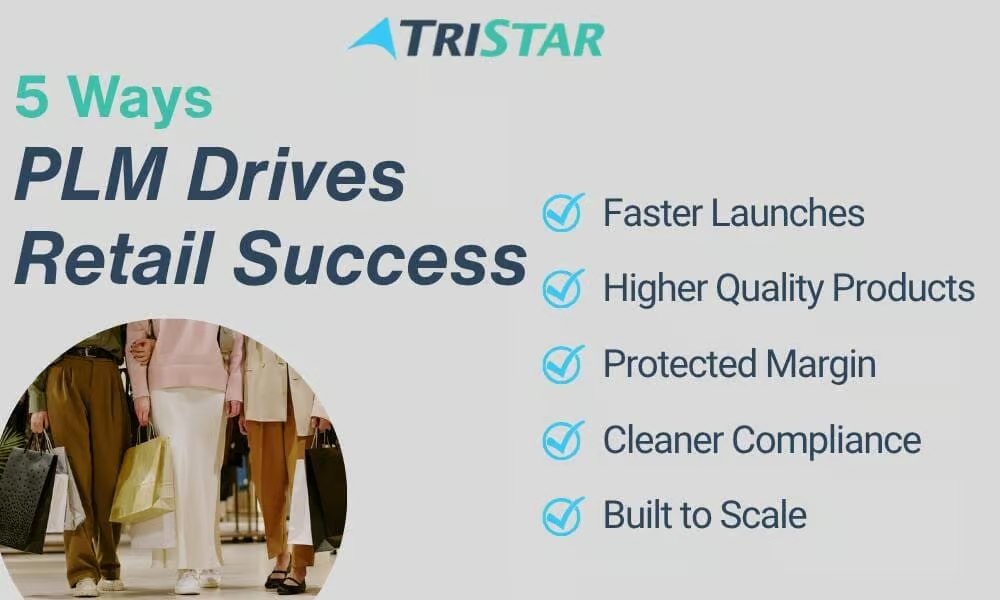
Consumer brands that win at retail invest in both the right tools and a thoughtful implementation strategy. PLM done right delivers measurable performance improvements across every retail-facing metric.
- Faster launches that capture trend windows and seasonal demand
- Higher quality and fewer field issues that improve reviews and reduce returns
- Cost discipline that protects margin under retailer pricing pressure
- Stronger retailer relationships through faster, cleaner asset and compliance delivery
- Scalable infrastructure to grow SKU count, expand categories, or add channels without rebuilding the data foundation
This is what separates consumer brands that scale from those that stall after a strong launch.

Connect Design, Data, and Retail with the Right PLM Partner
Consumer product success is no longer just a creative or marketing outcome. It is an engineering, data, and process outcome. PLM is the operational foundation that makes consistent, impactful products possible at scale and turns the design process from a bottleneck into a competitive advantage at retail.
Scale Your Consumer Product Line with TriStar PLM Expertise
TriStar Digital Thread Solutions brings more than 25 experts, 250+ years of combined PLM experience, and 500+ PTC Windchill implementations to every engagement. With deep expertise in PTC Creo, Windchill, KeyShot, ModelSearch, and Wincom extensions, TriStar helps consumer product brands design, implement, and optimize the PLM environment behind their best-selling products. Contact TriStar to get started.
How does product design impact retail success? Product design impacts retail success by determining shelf appeal, quality, return rates, time to market, and cost. Strong consumer product design improves conversion, protects margin, and meets retailer compliance and sustainability requirements before a product reaches the channel.
What are the phases of the consumer product design process? The consumer product design process moves through four phases: concept and market insight, industrial design and engineering, prototyping and validation, and manufacturing handoff and launch. Each phase produces deliverables that downstream teams depend on for retail readiness.
How does PLM support consumer product development? PLM supports consumer product development by consolidating CAD models, packaging files, supplier data, and compliance records into a single controlled environment. This gives engineering, marketing, and sourcing teams real time access to current data and eliminates version errors.
How can visualization tools speed up retail launches? Visualization tools like KeyShot generate photorealistic renders directly from CAD data, letting marketing produce retailer presentations, ecommerce assets, and AR content months before physical samples exist. This shortens the path from design to launch.
How does design reuse reduce consumer product costs? Design reuse reduces costs by letting engineers find and reuse validated components from past programs instead of redesigning from scratch. Geometry-based search tools cut redundant work, lower tooling investment, and reduce SKU complexity.
When should a consumer brand implement PLM? Consumer brands should implement PLM before SKU complexity, retailer requirements, or launch volume outpace manual systems. Early implementation establishes traceability and reuse from the start, and migration is also possible at any later growth stage.
TriStar Digital Thread Solutions welcomes questions. Feel free to CONTACT US if you can’t find what you’re looking for, or call us at 800-800-1714