Skip to content




May 6, 2026
AI Product Development: Why a Connected Digital Thread Beats Isolated AI Tools
READ TIME: 7 MINS
A Quick Overview: AI product development is no longer a CAD feature or a single tool. It is a lifecycle-wide discipline that connects concept, design, manufacturing, quality, and service through a shared digital thread. Manufacturers that win with artificial intelligence are not the ones with the flashiest AI models. They are the ones whose product data is clean, governed, and accessible across the enterprise. This post explains why a connected digital thread, anchored by PLM and PTC Windchill, turns AI from a point solution into a real competitive advantage.
What Is AI Product Development?
AI product development is the application of artificial intelligence and machine learning across the full product lifecycle, from concept and requirements to design, manufacturing, quality, service, and end-of-life. The goal is to automate repetitive tasks, surface deeper insights, and enable strategic decision-making across cross-functional teams.
For years, AI in product development meant one engineer using one smart feature inside one tool. That era is ending. Leading product teams now embed AI across the entire product development process, not just a single use case.
The shift happening right now:
- AI is moving from isolated point tools to lifecycle-wide intelligence.
- Generative AI, predictive analytics, and natural language processing are being applied to BOMs, change orders, supplier data, and field service feedback.
- The product manager’s role is expanding to include AI product management responsibilities like governing data, validating outputs, and managing human oversight.
What separates leaders from laggards
The differentiator is not which AI models a company licenses. It is whether the underlying product data is unified, governed, and trusted. A unified data foundation is what makes AI-driven product decisions reliable across the organization.
Why Isolated AI Tools Fall Short
Most AI initiatives in manufacturing stall because the AI is bolted onto fragmented data. Without a connected digital thread, AI cannot see across the product lifecycle, and the value collapses.
AI models are only as good as the data they are trained on. In product development, that data is often scattered across systems: dirty BOMs with duplicate parts, mismatched revisions between CAD, ERP, and MES, disconnected requirements that never tie back to as-built configurations, and orphaned service records that never inform the next design iteration.
When AI tools live inside individual point solutions, companies experience slower approvals, rework from stale data, compliance gaps, and broken feedback loops. The fix is structural. AI product development requires a unified data environment, not more disconnected AI features.
The Digital Thread: The Foundation of AI Product Development
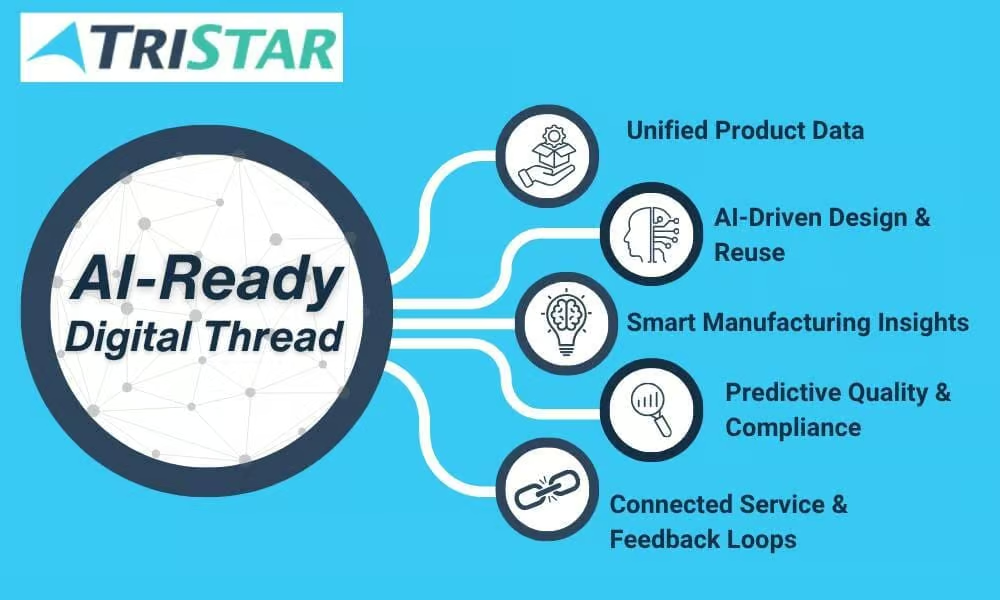
The digital thread is the connected data spine that links every stage of the product lifecycle, from initial requirements to in-field service data. It is the foundation that makes AI product development possible at enterprise scale.
A modern PLM platform like PTC Windchill acts as the central source of truth, holding the master record for parts, configurations, change orders, and compliance documentation. When AI models pull from a governed PLM environment, they pull from clean, traceable data, which turns AI from a guess into a real decision engine. Microsoft has described digital threads as the nervous system of industrial operations, grounding AI in unified operational, information, and engineering data. PTC and Microsoft are now collaborating to extend Windchill’s digital thread into Microsoft Fabric, integrating ERP and MES data to power AI-driven insights across the enterprise.
AI Across the Product Lifecycle: A Stage-by-Stage View
AI product development creates value at every stage of the product lifecycle, not just in design. Below is how artificial intelligence is being applied at each phase, and why a connected digital thread amplifies the impact at each one.
Concept and Requirements
The earliest stage is where AI prevents the most expensive mistakes downstream.
- AI-assisted requirements analysis flags ambiguous, conflicting, or incomplete requirements before they reach engineering.
- Predictive analytics uses historical project data to forecast schedule risk, scope creep, and integration challenges.
- Application Lifecycle Management platforms like Codebeamer tie requirements directly to design, test, and verification, giving AI a complete traceability graph to work with.
Engineering and Design
This is the most well-known frontier for AI in product development, but it is just one piece of the story.
- Generative design and real-time simulation inside PTC Creo allow engineers to explore thousands of design alternatives and validate them in seconds.
- For a deeper look at how AI is reshaping the CAD environment, see our previous post on PTC Creo AI Optimization.
The key insight: AI in design only delivers full ROI when those optimized models flow into a connected PLM environment for the rest of the lifecycle.
Parts Reuse and Standardization
Duplicate parts are one of the most expensive hidden costs in manufacturing. AI-adjacent technology fixes that.
- Geometry-based search tools like MAIT ModelSearch let engineers find existing parts by 3D shape rather than part number.
- Reuse cuts duplicate part creation, lowers tooling and inventory costs, and reduces supplier complexity.
- Standardization improves quality assurance by concentrating volume on validated, proven components.
Manufacturing and Production
On the shop floor, AI turns connected data into operational performance.
- AI-driven process planning automates routings, work instructions, and resource allocation.
- Predictive maintenance uses real-time machine data to flag failures before they cause downtime.
- Factory analytics surface bottlenecks, scrap trends, and throughput patterns that humans miss.
- Windchill MPMLink ties design intent to manufacturing process plans, so the shop floor always runs against the latest revision.
Quality and Regulatory Compliance
In aerospace, medical devices, and automotive, AI without governance is a liability. AI tied to a validated PLM environment is an advantage.
- Predictive quality models identify nonconformance risk before parts reach inspection.
- Anomaly detection flags deviations across suppliers, plants, and product lines.
- Automated nonconformance routing accelerates CAPA cycles while maintaining audit-ready traceability.
- Validated PLM ensures every AI-influenced decision is documented for regulators.
Service and Aftermarket
The lifecycle does not end at shipment. AI in service is where the feedback loop closes.
- Predictive service intelligence uses connected product data to forecast failures and trigger proactive maintenance.
- AR-assisted technicians powered by tools like PTC Vuforia get real-time guidance overlaid on physical equipment.
- AI-driven service parts ordering ensures the right component reaches the right technician on the first visit.
- Field data flows back into the digital thread, informing the next product design iteration.
This closed-loop architecture is one of the most powerful new opportunities in modern product management.
The Capabilities That Make AI Product Development Possible
AI product development is built on a stack of capabilities, not a single platform. Each capability below contributes to a connected, AI-ready product lifecycle.
- Connected digital thread across CAD, PLM, ALM, MES, and IoT systems
- Clean, governed master data and rigorous configuration control
- Open APIs and integrations between PTC products and enterprise systems
- Custom extensions that close functional gaps, including Wincom Windchill Extensions
- CAD automation and engineer-to-order workflows
- Cloud and SaaS scalability through Windchill+ and TriStar Cloud Solutions
- Foundational AI literacy across product teams, including basic prompt engineering and human oversight practices
Together, these capabilities turn AI from a feature into a strategy.
Common Roadblocks (and How to Clear Them)
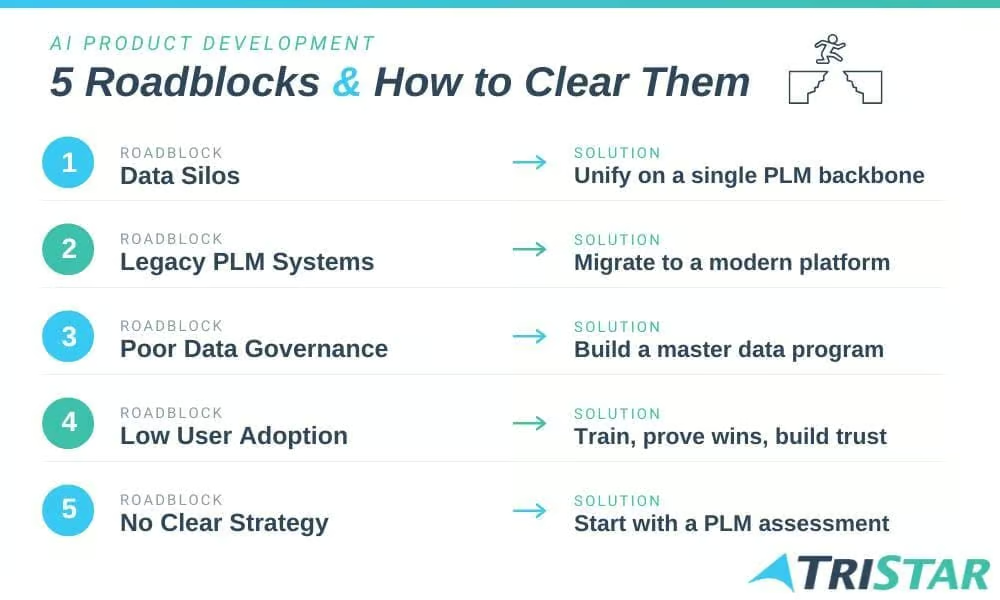
Most manufacturers in the United States face the same set of obstacles when adopting AI product development. The good news: each one has a known solution.
Roadblock 1: Data silos
Disconnected CAD, ERP, MES, and CRM systems prevent AI from seeing the full picture. Solution: consolidate on a unified PLM backbone and define clear integration patterns.
Roadblock 2: Legacy PLM systems
Older PLM platforms cannot expose data to modern AI tools or cloud services. Solution: evaluate a PLM migration to a modern, supported platform.
Roadblock 3: Poor governance
Duplicate parts, inconsistent metadata, and uncontrolled change orders poison AI models. Solution: establish a master data governance program before scaling AI.
Roadblock 4: Change management and adoption
Engineers and product teams will not use tools they do not trust. Solution: invest in training, real-world case studies, and feedback loops that show measurable wins.
Roadblock 5: Lack of strategy
Pilot projects without lifecycle context become orphans. Solution: start with a PLM Capabilities Assessment and align AI investments to business outcomes.

How TriStar Helps Manufacturers Build an AI-Ready Lifecycle
TriStar Digital Thread Solutions helps manufacturers turn product development into a competitive advantage by making the digital thread practical, not theoretical.
What sets TriStar apart
- More than 25 experts with over 250 years of combined PLM and PTC Windchill experience
- 500+ Windchill implementations and over 5,000 customers worldwide
- One of the largest global resellers of PTC Windchill, Creo, and the broader PTC suite
- Dual expertise across Creo and Windchill, so design intent flows seamlessly into lifecycle management
Services that support AI product development
- PLM Capabilities Assessment and digital transformation consulting
- PLM Implementation and system migration
- Custom Wincom Windchill Extensions that close gaps in standard PLM offerings
- Virtual and physical training, plus ongoing support and maintenance
- Guidance on AI success with PTC products
Getting Started: A Practical Roadmap for AI Product Development
The best practice for adopting AI product development is to start with the foundation, then layer on use cases. Skipping ahead to AI tools without a connected digital thread is the most common reason these initiatives fail.
Step 1: Assess current PLM maturity and data quality
Use a structured PLM Capabilities Assessment to map current systems, data flows, and process gaps. This is your baseline.
Step 2: Consolidate the digital thread
Unify CAD, PLM, ALM, and manufacturing data on a single governed platform. Windchill is the most common backbone for this.
Step 3: Identify high-ROI AI use cases by lifecycle stage
Pick one or two use cases per stage. Examples: requirements quality (concept), parts reuse (design), predictive maintenance (manufacturing), predictive quality (compliance), service intelligence (aftermarket).
Step 4: Pilot, measure, and scale
Run focused pilots with clear KPIs. Use real-world data and real-world case studies from your own operations to validate before scaling. Build feedback loops between users and the product team.
Step 5: Govern, train, and continuously improve
Establish data governance, document ethical considerations, and invest in ongoing training. Continuous learning is what keeps AI product development effective as models, regulations, and markets evolve.
Turn Product Development Into Your Competitive Advantage
AI product development is a strategy, not a feature. The companies that treat it as a lifecycle discipline, anchored by a connected digital thread, will outpace competitors who chase isolated AI tools.
TriStar Digital Thread Solutions helps manufacturers make that shift, from initial assessment through implementation, custom tooling, training, and ongoing support. With over 250 years of combined PTC expertise and more than 5,000 customers worldwide, TriStar has the experience to deliver a measurable competitive edge.
Contact TriStar today to schedule a PLM Capabilities Assessment and start building an AI-ready product lifecycle.
TriStar Digital Thread Solutions welcomes questions. Feel free to CONTACT US if you can’t find what you’re looking for, or call us at 800-800-1714