Skip to content




September 7, 2023
AI CAD Design: How Artificial Intelligence Is Reshaping the Design Process
READ TIME: 5.2 MINS
Artificial intelligence is changing how engineers and designers build products — and CAD software is at the center of that shift. AI CAD design combines AI algorithms, machine learning, and generative design with traditional computer-aided design tools to automate repetitive tasks, speed up product development, and surface design options that manual design workflows would miss entirely.
For any mechanical engineer or designer looking to reduce iteration time, cut costs, and produce more efficient designs, understanding how AI is reshaping the CAD industry is no longer optional. Here’s what you need to know.
What is AI CAD Design?
AI CAD design refers to the integration of AI into CAD systems, going beyond basic drafting and modeling to create tools that learn, adapt, and assist in real time. Where traditional CAD relies on the designer to drive every decision, AI-powered tools use machine learning and neural networks to analyze data, predict outcomes, and recommend optimal solutions based on defined constraints.
Major players across the CAD industry are already building AI capabilities directly into their platforms. PTC has embedded AI-driven generative design and real-time simulation into Creo. The global AI market is projected to grow at over 37% CAGR through 2030, a clear signal that AI systems in design are here to stay.
The bottom line: AI CAD isn’t replacing the engineer or designer. It’s acting as a design assistant that handles the heavy computational lifting so your team members can focus on creative problem-solving and innovation.
How AI Is Changing the Design Process
Generative Design and Faster Iteration
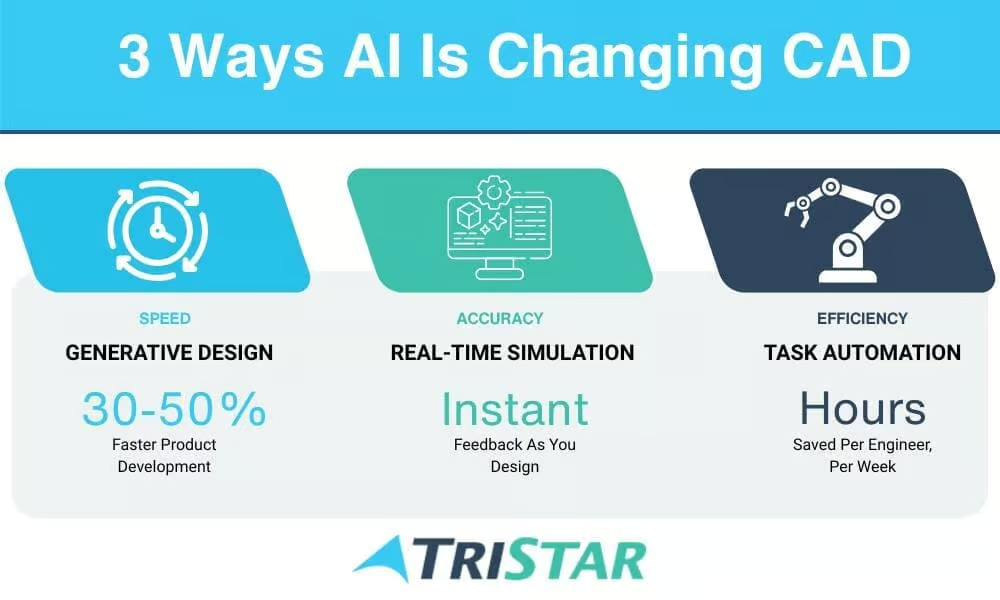
Generative design is one of the most visible applications of AI in CAD today. A generative design tool takes your input parameters — material properties, weight targets, load conditions, manufacturing process constraints — and uses AI algorithms to generate dozens or even hundreds of design options that meet those criteria.
Instead of a designer manually creating and testing a handful of concepts, generative AI explores the full solution space and delivers innovative design alternatives in a fraction of the time. The result is faster iteration, reduced material waste, and products optimized for both performance and manufacturability.
PTC Creo’s generative design capabilities, for example, allow engineers to define constraints and let the software produce ready-to-manufacture geometry, including designs optimized for additive manufacturing.
According to Design News, documented generative design programs have cut product development time by 30–50% by enabling engineers to evaluate more valid concepts upfront and combine optimization with simulation earlier in the process.
Real-Time Simulation and Feedback
Traditionally, simulation happened at the end of the design process. A designer would complete a model, hand it off for analysis, wait for results, then revise. AI-driven tools are collapsing that loop.
PTC Creo Simulation Live integrates real-time simulation directly into the modeling environment. As a designer modifies geometry, the software provides immediate feedback on structural integrity, thermal performance, and fluid dynamics. This means engineers can evaluate and refine in real time rather than waiting days for separate analysis cycles.
This shift plays a crucial role in reducing rework and catching potential failures early, before they become expensive problems later in the manufacturing process.
Automating Repetitive Tasks
A significant portion of a designer’s day is spent on repetitive tasks: dimensioning, feature recognition, design validation checks, file management. AI tools are increasingly handling these lower-value activities automatically.
By offloading repetitive tasks to AI, team members gain time back for higher-impact work: exploring new design concepts, collaborating with stakeholders, and solving complex engineering problems. The cost savings add up quickly, especially for organizations running large engineering teams across multiple product lines.
PTC Creo and AI CAD Design
With a strong reputation in the CAD industry, PTC Creo was one of the first platforms to bring meaningful AI capabilities into its core toolset. Here’s how Creo puts AI CAD design to work:
PREDICT AND PREVENT DESIGN FLAWS
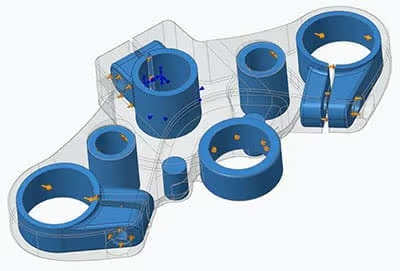
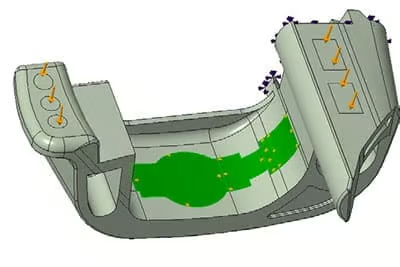
PTC Creo Generative Design uses AI to automatically generate designs based on your constraints, including material properties and manufacturing processes, and additive manufacturing requirements. This leads to faster development, higher quality, and ready-to-manufacture designs.
ENHANCE DESIGN EFFICIENCY
PTC Creo Simulation Live provides AI-enabled, real-time simulation feedback so engineers can evaluate and refine designs without time-consuming iteration cycles.
OPTIMIZE PERFORMANCE
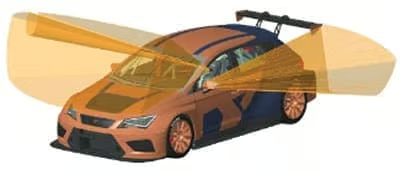
PTC Creo’s Human Factors Analysis suggests early-stage design modifications for aerodynamics, weight reduction, and structural integrity — surfacing insights that manual design review would likely miss.
Real-World Applications Across Industries
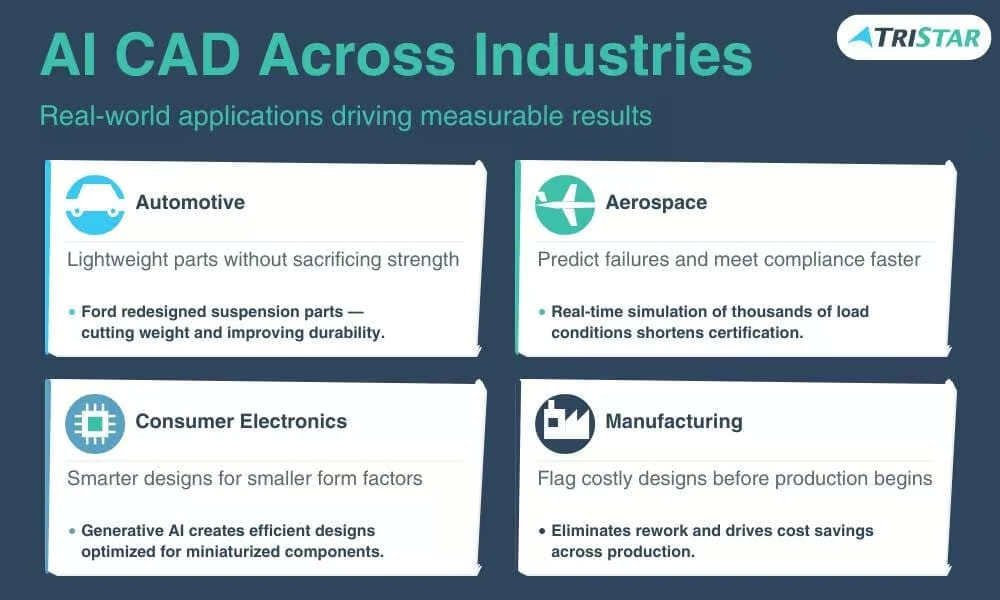
AI CAD design is already delivering measurable results across sectors where product development speed and precision matter most.
In automotive, engineers use AI-powered tools to lightweight vehicle components while maintaining structural integrity, directly improving energy efficiency and reducing emissions. Ford, for instance, has used generative design to redesign suspension components, cutting weight while improving durability.
In aerospace, where compliance and precision are non-negotiable, AI systems help refine designs, predict potential failures, and ensure components meet strict regulatory standards. The ability to simulate thousands of load conditions in real time has shortened certification timelines.
In consumer electronics, AI helps designers balance aesthetics with functionality across increasingly compact form factors and generates efficient designs for everything from wearables to smartphones.
Across manufacturing, AI is improving the link between design and production. AI models trained on manufacturing data can flag designs that will be difficult or costly to produce before they ever leave the CAD environment — eliminating rework and driving cost savings.
The Role of AI in the Future of CAD
The integration of AI into CAD tools is accelerating. Industry analysts at Gartner have identified generative AI as one of the most transformative technologies for engineering and design workflows over the next decade.
Looking ahead, expect AI to move from assisting the design process to actively co-creating. AI models will generate entire products from high-level specifications. Designers will spend more time curating and refining AI-generated concepts and less time on manual design from scratch. The creative journey doesn’t go away — it evolves.
For organizations that want to stay competitive in product development, building AI capabilities into their engineering stack is the key to moving faster and designing smarter.
How TriStar Helps You Put AI CAD Design to Work
Adopting AI-powered CAD tools is one thing. Getting real value from them is another. That’s where TriStar comes in.
As one of the largest PTC value-added resellers globally, TriStar brings over 250 years of combined PLM and PTC experience to every engagement. With more than 500 Windchill implementations and over 5,000 customers, TriStar’s team understands how to connect AI-driven CAD tools like PTC Creo to your broader product development workflow, from strategy and configuration through training and ongoing support.
Whether you’re exploring generative design for the first time, rolling out Creo Simulation Live, or building a full digital thread strategy, TriStar helps your engineering team work smarter and move faster.
Ready to get started designing the products of the future? Learn more about PTC Creo 11 or start your 30-day free trial!
Links to Other Pages
- IoT Remote Monitoring: This comprehensive guide will help you discover how IoT remote monitoring can improve performance and efficiency in your operations.
- Creo Parametric: Learn about the advanced features and capabilities of Creo Parametric for precise 3D CAD modeling.
- AI in Architecture: Explore how AI is revolutionizing design and construction in architecture.
- Power of Digital & AI to Select Projects Webinar: Check out the power of digital and AI in project selection and management.
- AIoT Platform – Accelerate Digital Transformation: Discover how an AIoT platform can accelerate your digital transformation efforts.
TriStar Digital Thread Solutions welcomes questions. Feel free to CONTACT US if you can’t find what you’re looking for, or call us at 800-800-1714